 United States
 United Kingdom
 Canada
 Australia
 India
India Germany
 France
 Japan
Japan Brazil
 South Africa
 Italy
Italy Spain
Spain Mexico
 South Korea
 Netherlands
 Singapore
 United Arab Emirates
 New Zealand
 Sweden
 Switzerland
1. Introduction
In the high-velocity Trade and Distribution sector, workforce agility is the primary driver of competitive advantage. Client X, a leader in this space, faced significant operational bottlenecks due to fragmented legacy systems. Vranya GlobalTech deployed a comprehensive, cloud-native HRMS integrated with the client’s existing ERP to bridge the gap between human capital management and operational excellence. This implementation transitioned the HR department from a back-office administrative function to a strategic business partner.
2. The Challenge: Core Pain Points
Prior to Vranya’s intervention, Client X suffered from “Administrative Friction,” characterized by:
• Data Silos & Version Control: Employee records existed in disconnected spreadsheets, leading to conflicting data and a “single source of truth” crisis.
• Compliance Vulnerability: Manual payroll and statutory reporting (PF, ESI, Labor Laws) were prone to human error, risking legal penalties.
• The “Shadow” Workforce: With field staff in distribution, the lack of geofencing meant attendance was based on “trust” rather than verified data.
• Recruitment Lag: High turnover in the trade sector was met with slow, manual hiring processes, leading to vacant critical roles and lost revenue.
• Hidden Costs: Manual tracking of assets (laptops, vehicles, handheld scanners) led to significant financial leakage due to unrecovered equipment.
• Employee Dissatisfaction: Delayed expense reimbursements and lack of transparency in loan approvals created a culture of frustration.
3. Strategic Objectives
- Unify: Create a centralized digital core for all employee data.
- Automate: Eliminate 90% of manual HR interventions in payroll and attendance.
- Empower: Shift to an Employee Self-Service (ESS) model to reduce HR tickets.
- Analyze: Provide leadership with live “People Analytics” for data-driven scaling.
4. The Vranya Solution: Implementation Framework
Vranya GlobalTech did not just provide software; we re-engineered the HR workflow through:
- Phase 1: Discovery & Cleanse: Audit of legacy data and organizational hierarchy mapping.
- Phase 2: ERP Integration: Ensuring the HRMS “talks” to Finance modules for real-time cost-center accounting.
- Phase 3: Module Rollout: Agile deployment of Core HR, Payroll, and Performance modules.
- Phase 4: Mobile Enablement: Launching the mobile app for field staff in the distribution network.
5. The Transformation: Before vs. After
| Feature | Pre-Implementation (The Chaos) | Post-Implementation (The Milestone) |
|---|---|---|
| Attendance | Manual registers; high proxy rates. | Biometric/Geo-fenced app; 100% accuracy. |
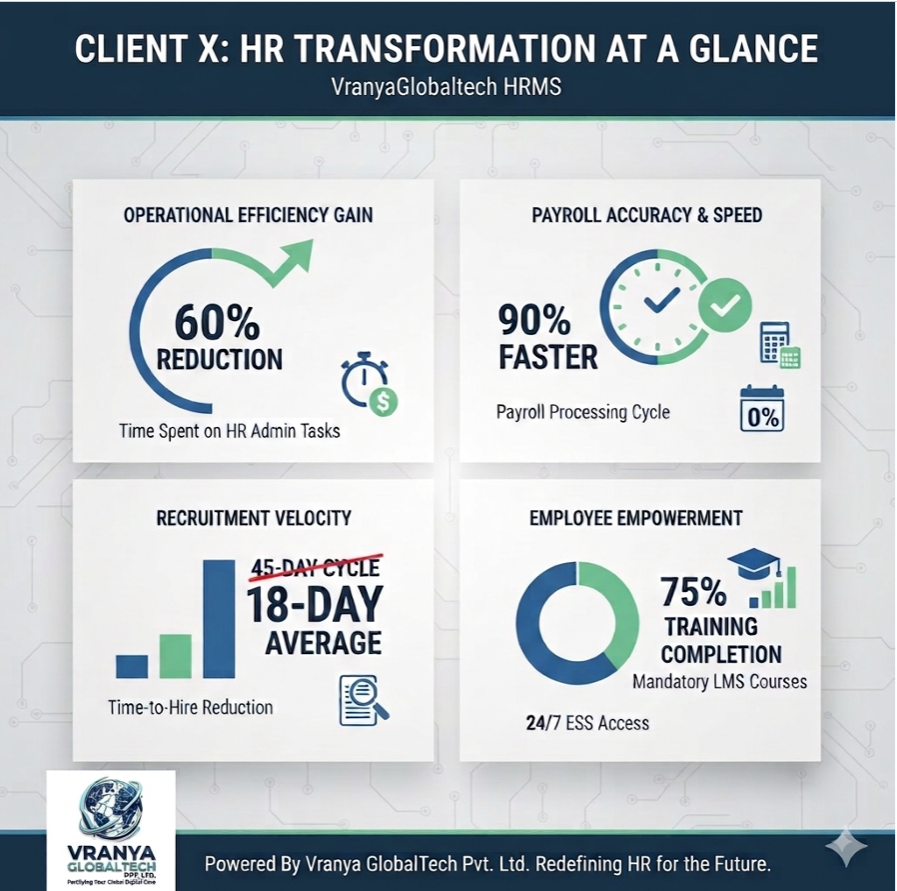
| Payroll Cycle | 7–10 days of manual calculation. | Generated in minutes via automated triggers. |
| Employee Queries | Constant emails/calls to HR for payslips. | 24/7 access via ESS Portal/Mobile App. |
| Recruitment | Physical CV piles; 45-day cycle. | AI Parsing; 18-day average hiring cycle. |
| Expense Claims | Paper-based; 3-week reimbursement. | Digital upload; 3-day approval workflow. |
| Asset Tracking | Spreadsheet-based; high loss rate. | Automated lifecycle tracking; 0% leakage. |
6. Detailed Functional Impact
A. Centralized Database & Hierarchy
We mapped the entire organizational DNA. Digital files now include movement history, ensuring that when a manager in the distribution hub moves, their subordinates are automatically re-routed in the approval workflow.
B. Precision Payroll & Compliance
The system automatically calculates 40+ components, including variable pay for sales teams, statutory deductions, and arrears. Integration with performance cycles ensures that increments are reflected instantly without manual data entry.
C. Strategic Recruitment & Onboarding
By digitizing the “Hire-to-Onboard” journey, Client X can now scale their warehouse staff overnight. Digital offer letters and automated document collection have reduced administrative “onboarding ghosting” by 40%.
D. Asset & Loan Management
The HRMS acts as a digital ledger. Every handheld device in the distribution chain is tagged to an employee ID. Loan eligibility is now calculated by the system based on tenure and salary, removing bias from the approval process.
7. Business Gains & Operational Simplification
- Operational Velocity: Managers spend 60% less time on administrative approvals and more time on supply chain optimization.
- Financial Transparency: Real-time “Cost-to-Company” (CTC) reports allow the Finance team to see the exact impact of headcount on the bottom line.
- Cultural Shift: The Learning Management System (LMS) has fostered a culture of upskilling, with a 75% completion rate for mandatory safety and compliance training.
- Strategic Scalability: Client X can now open new distribution centers and integrate new staff into the system within 24 hours.
8. Conclusion
The implementation of Vranya GlobalTech HRMS at Client X is a testament to how technology can de-clutter a complex organizational structure. By moving from fragmented, manual processes to an integrated, AI-ready ecosystem, Client X has not only saved thousands of man-hours but has also built a resilient foundation for future growth. Vranya has successfully turned HR from a cost center into an engine of efficiency.